

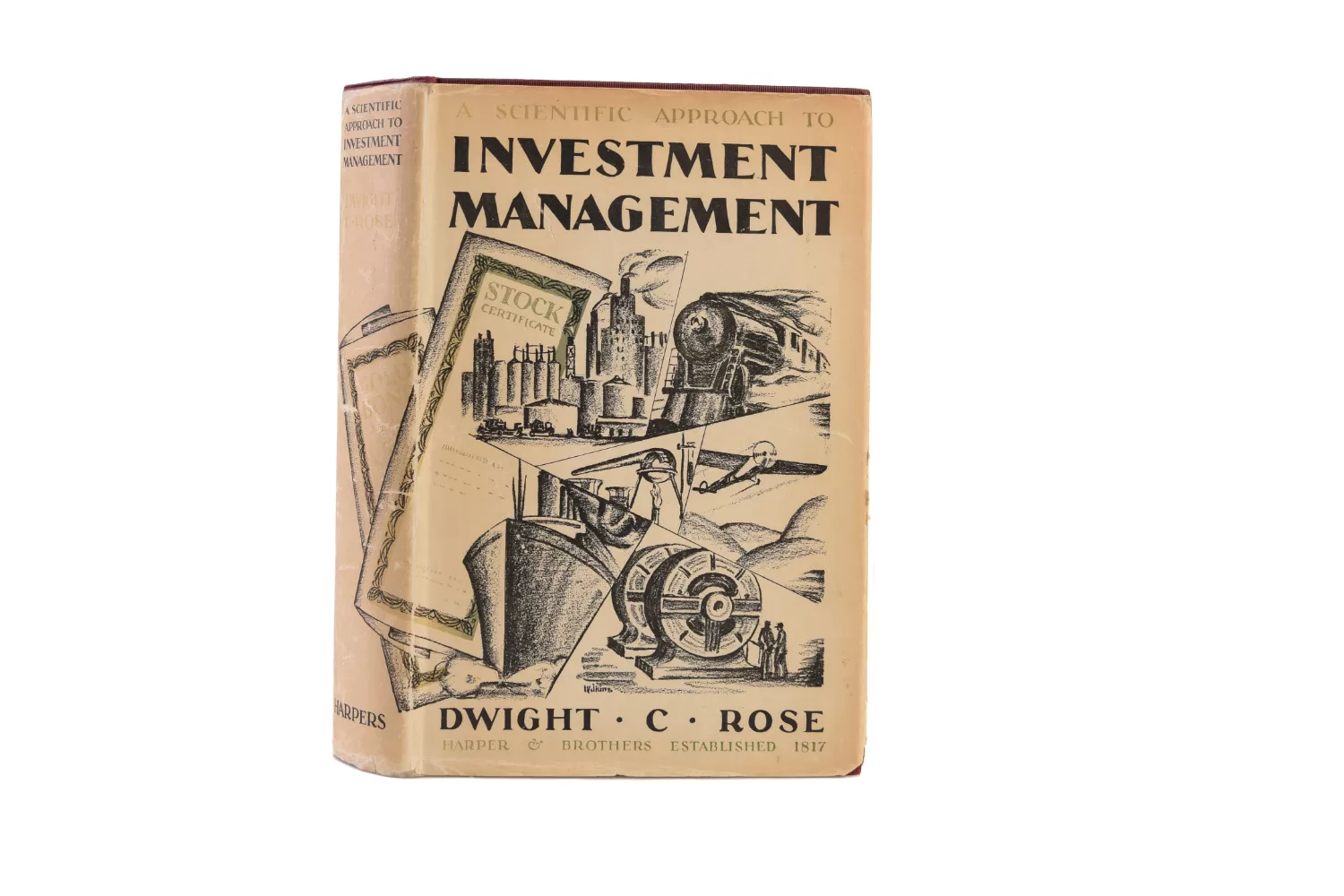
Dwight C. Rose's book "A Scientific Approach to Investment Management" represents a landmark in financial literature by addressing investment management from a rigorous, data-driven perspective. In this article, we will explore in depth the key concepts presented in the book, their relevance to the investment world, and how they can be applied by both professional and individual investors.
The Search for Objectivity in an Uncertain World
One of the fundamental premises underlying Rose's scientific approach is the need to replace intuition and subjective opinions with rigorous, data-driven analysis. Just as a scientist seeks universal laws through experimentation, a scientific investor seeks to identify patterns and relationships in financial markets that can be used to make more informed decisions.
Diversification: Beyond Modern Portfolio Theory
Rose devotes a considerable portion of the book to diversification, a fundamental principle in investment management. However, he goes beyond simple modern portfolio theory (MPT), exploring more sophisticated diversification strategies that take into account factors such as asset correlation, volatility, and market regimes.
- Diversification beyond traditional asset classes: The author argues that investors should consider a broader range of assets, including real estate, commodities, and alternative assets, to build more diversified portfolios that are resilient to market fluctuations.
- Dynamic diversification: Unlike static portfolios, Rose proposes a dynamic approach in which portfolio composition is periodically adjusted in response to changes in market conditions and the outlook for different assets.

Portfolio Optimization: Finding the Perfect Balance
Portfolio optimization is another central topic in the book. Rose presents a variety of optimization techniques that allow investors to construct portfolios that maximize expected returns for a given level of risk.
- Mean-variance quadratic optimization: This is one of the most widely used methods for portfolio optimization, but Rose also discusses other, more sophisticated techniques that take into account factors such as the skewness and kurtosis of return distributions.
- Stochastic optimization: This approach allows for modeling uncertainty in financial markets and building portfolios that are robust to a wide range of possible scenarios.
The Capital Asset Pricing Model (CAPM)
The CAPM is a fundamental tool in asset valuation and portfolio construction. Rose provides a detailed explanation of the CAPM and its implications for investment management.
- Limitations of the CAPM: The author acknowledges the CAPM's limitations, such as its assumption that investors are risk-averse and that markets are efficient. However, he argues that the CAPM remains a useful tool for understanding the relationship between risk and return.
- CAPM Extensions: Rose discusses several extensions of the CAPM that attempt to address its limitations, such as the Fama and French three-factor model and the Carhart four-factor model.
The Efficient Markets Hypothesis: Myth or Reality?
The efficient markets hypothesis (EMH) is a controversial theory that holds that asset prices reflect all available information and that consistently outperforming the market is impossible. Rose examines the empirical evidence for and against the EMH and concludes that, although markets are generally efficient, there are opportunities to generate alpha through careful active management.
- Market anomalies: The author discusses several market anomalies that appear to contradict the EMH, such as the size effect, the value effect, and the momentum effect.
- The importance of active management: Rose argues that while most investors should invest in index funds, there is a place for active management in certain situations, such as managing large portfolios or investing in emerging markets.

Risk Management: Protecting Wealth
Risk management is an essential part of any investment strategy. Rose presents a variety of tools and techniques for measuring and managing risk, including:
- Value at Risk (VaR): VaR is a measure of the maximum loss that an investor can expect to suffer over a given period of time with a certain probability.
- Stress testing: Stress testing involves evaluating the performance of a portfolio under extreme market scenarios.
- Coverage: Hedging is a strategy used to reduce the risk of loss in an investment.
In summary
"A Scientific Approach to Investment Management" offers a deep and comprehensive look at investment management. By combining theory and practice, the book provides investors with the tools and knowledge needed to make more informed and rational investment decisions.
Rose's scientific approach to investment management offers a sound alternative to investment strategies based on intuition or current fads. By adopting a rigorous, data-driven approach, investors can increase their chances of long-term success.
Both you and your company can also invest in quality companies.
See more notes from our blog:
-

Investment Management: 98 Años Del Libro Pionero En Finanzas
On February 27, 1928, Dwight Rose published A Scientific Approach to Investment Management, a fundamental book in the world of finance. I discovered its practical advice.
-

Volkswagen: A 90 Años de su Terrorífico Surgimiento
On February 26, 1936, the result of an agreement between Ferdinand Porsche and the German government, the "people's car," Volkswagen, was born. Discover its dark history and how corporate responsibility is essential today.
-
Money Issue: Lessons from Lincoln and the Greenbacks in 1862
On February 25, 1862, U.S. President Lincoln signed a law authorizing the issuance of currency to finance the Civil War. Let's see what lessons we can learn from this currency issuance.


Aeronautics saving Apple Financial Advisor banks Berkshire Hathaway Stock market bonds bubble Dot-com bubble byma commodities South Sea Company Financial advice Cryptocurrencies crisis subprime crisis free finance course economy Start investing pyramid scheme USA Facebook finance Personal finances IBM inflation England finance books investment books LTCM financial mentoring Argentine market stock market international market Meta Microsoft Nasdaq Oil Russia Steve Jobs Technology value investing Wall Street Warren Buffett
